Stone churches that survived centuries of earthquakes, mountain terraces carved by hand two thousand years ago, a river that flows underground straight into the sea and a reef in the middle of the Sulu Sea that only opens for three months a year: the Philippines packs a remarkable range of heritage into its 7,600 islands.
How many UNESCO World Heritage Sites are in the Philippines? As of 2026 the official World Heritage List includes 6 sites: 3 cultural sites (the Baroque Churches, the Rice Terraces of the Cordilleras and the Historic City of Vigan) and 3 natural sites (Tubbataha Reefs, the Puerto Princesa Underground River and Mount Hamiguitan). Several more places are waiting on the country’s Tentative List.
Free Consultation: Tell our local team which Philippine World Heritage Sites you would like to see and get a free, no-obligation trip plan.
The travel experts from PhilippinesAssist help you with current information, permits, flights between the islands and booking local guides, private drivers and day trips, so you can focus on the churches, terraces and reefs instead of the logistics.
How we counted: this list follows the official World Heritage List of the UNESCO World Heritage Centre (whc.unesco.org) for the Philippines, checked in November 2026. Sites with several parts, such as the four Baroque Churches or the five rice terrace clusters, count as one property, exactly as UNESCO lists them. Sites that are only on the Tentative List are covered separately below the table.
Below you’ll find all 6 UNESCO World Heritage Sites of the Philippines, grouped into cultural and natural sites, each with the year of inscription, a short description, practical visit information, the official UNESCO page and a Google Maps link. A summary table and answers to common questions follow at the end.
🗺️ UNESCO World Heritage Sites in the Philippines
Cultural sites (3)
- Baroque Churches of the Philippines
- Rice Terraces of the Philippine Cordilleras
- Historic City of Vigan
Natural sites (3)
- Tubbataha Reefs Natural Park
- Puerto-Princesa Subterranean River National Park
- Mount Hamiguitan Range Wildlife Sanctuary
Cultural World Heritage Sites
⛪ Baroque Churches of the Philippines
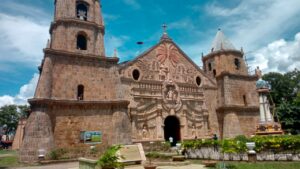
Four Spanish-era churches built between the late 16th and the 18th century: San Agustín Church in Intramuros (Manila), San Agustín Church in Paoay (Ilocos Norte), Nuestra Señora de la Asunción in Santa Maria (Ilocos Sur) and Santo Tomás de Villanueva in Miagao (Iloilo). Their massive walls and buttresses, a style often called “earthquake baroque”, blend European design with local craftsmanship, best seen in the carved coral-stone facade of Miagao.
All four are still active parish churches, so dress modestly and avoid entering during Mass or weddings.
Inscribed: 1993
Type: Cultural
Where: Intramuros (Manila), Paoay near Laoag, Santa Maria south of Vigan, and Miagao south-west of Iloilo City
Getting there: San Agustín is in the walled city of Intramuros in central Manila. Paoay is a short drive from Laoag airport, Santa Maria about an hour south of Vigan by road, and Miagao about an hour from Iloilo City
Best season: The dry season, roughly December to May, is the most comfortable for combining the churches with sightseeing
Time needed: 30 to 60 minutes per church; seeing all four means combining Manila, the Ilocos coast and Iloilo
Explore: Intramuros walking day in Manila
Official page: whc.unesco.org
Map: Show on Google Maps
🌾 Rice Terraces of the Philippine Cordilleras
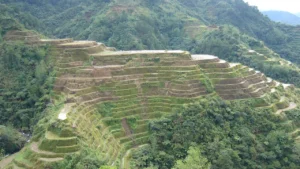
Built by the Ifugao people and farmed for around two thousand years, these terraces climb the mountainsides of the Cordillera like giant staircases. UNESCO protects five clusters: Batad and Bangaan (both in Banaue), Mayoyao, Hungduan and Nagacadan in Kiangan. The well-known viewpoint terraces right above Banaue town are not one of the five inscribed clusters, so Batad is the classic place to see a UNESCO cluster up close.
The site was on the List of World Heritage in Danger from 2001 to 2012, and its survival still depends on young farmers keeping the terraces in use.
Inscribed: 1995
Type: Cultural
Where: Ifugao province, northern Luzon, with Banaue as the usual base
Getting there: Around 9 to 10 hours by overnight bus or private car from Manila to Banaue, then by road to the Batad saddle and a 30 to 60 minute walk down to the village
Best season: Dry months from about February to May are best for trekking; the terraces are greenest after planting and turn golden before the harvest around June and July
Time needed: 2 to 3 days including the journey from Manila
Explore: Batad rice terraces trek guide
Official page: whc.unesco.org
Map: Show on Google Maps
🏘️ Historic City of Vigan
Vigan is the best-preserved Spanish colonial town in Asia, founded in the 16th century. Its cobbled streets, above all Calle Crisologo, are lined with stone-and-timber mansions that mix Philippine, Chinese and European architecture, and horse-drawn kalesas still carry visitors through the old quarter.
Come early in the morning or after sunset, when the day-trippers have gone and the lanterns light the old houses.
Inscribed: 1999
Type: Cultural
Where: Vigan City, Ilocos Sur, on the north-west coast of Luzon
Getting there: Fly from Manila to Laoag and continue by road for about 1.5 to 2 hours, or travel 8 to 9 hours by road or overnight bus from Manila
Best season: November to May, the dry season on the Ilocos coast
Time needed: 1 to 2 days, easily combined with the Paoay and Santa Maria churches
Explore: Vigan travel guide
Official page: whc.unesco.org
Map: Show on Google Maps
Natural World Heritage Sites
🐠 Tubbataha Reefs Natural Park
Two atolls and the Jessie Beazley Reef in the middle of the Sulu Sea form one of the richest coral reefs on the planet, with sheer walls, sharks, turtles, manta rays and huge schools of fish. There are no hotels and no day trips: the reefs are strictly protected and visited only by licensed liveaboard boats.
It is a destination for certified, experienced divers rather than snorkellers or beginners.
Inscribed: 1993, extended 2009
Type: Natural
Where: In the Sulu Sea, roughly 150 km south-east of Puerto Princesa, Palawan
Getting there: Liveaboard boats depart from Puerto Princesa and cross overnight to the reefs
Best season: Only mid-March to mid-June, when the sea is calm enough for the crossing
Time needed: Liveaboard trips usually last about a week
Explore: Tubbataha liveaboard diving trip
Official page: whc.unesco.org
Map: Show on Google Maps
🚣 Puerto-Princesa Subterranean River National Park
An underground river about 8 km long winds through a limestone cave system and flows directly into the sea, beneath a mountain-to-sea landscape of forest, karst and beach. Visitors explore the first stretch of the cave by paddle boat with a guide, past huge chambers, stalactites and bats.
Daily visitor numbers are limited and permits are required, so it pays to book ahead in the busy season.
Inscribed: 1999
Type: Natural
Where: Sabang, on the west coast of Palawan, north of Puerto Princesa
Getting there: About 2 hours by road from Puerto Princesa to Sabang wharf, then a short boat ride to the cave entrance
Best season: November to May; boat trips can be suspended when the sea is rough
Time needed: A full day trip from Puerto Princesa, or an overnight stay in Sabang
Explore: Underground River tour guide
Official page: whc.unesco.org
Map: Show on Google Maps
🌿 Mount Hamiguitan Range Wildlife Sanctuary
A mountain ridge on the Pujada Peninsula with forest that changes from lowland rainforest to a rare “bonsai forest” of centuries-old dwarf trees near the summit. It is home to the Philippine eagle and to plants found nowhere else, including an endemic pitcher plant.
This is the least visited of the six sites. Summit treks are limited and must be arranged in advance with the protected area management and local guides.
Inscribed: 2014
Type: Natural
Where: Near Mati City, Davao Oriental, in south-eastern Mindanao
Getting there: Around 3 to 4 hours by road from Davao City to Mati, then onward to the sanctuary trailheads
Best season: Rain is possible all year; the drier months, roughly March to May, are usually best for trekking
Time needed: 2 to 3 days including travel from Davao and the trek
Official page: whc.unesco.org
Map: Show on Google Maps
Philippines UNESCO World Heritage Sites at a Glance
| # | World Heritage Site | Inscribed | Type | Region |
|---|---|---|---|---|
| 1 | Baroque Churches of the Philippines | 1993 | Cultural | Manila, Ilocos Norte, Ilocos Sur, Iloilo |
| 2 | Rice Terraces of the Philippine Cordilleras | 1995 | Cultural | Ifugao (Cordillera) |
| 3 | Historic City of Vigan | 1999 | Cultural | Ilocos Sur |
| 4 | Tubbataha Reefs Natural Park | 1993, extended 2009 | Natural | Sulu Sea (Palawan) |
| 5 | Puerto-Princesa Subterranean River National Park | 1999 | Natural | Palawan |
| 6 | Mount Hamiguitan Range Wildlife Sanctuary | 2014 | Natural | Davao Oriental (Mindanao) |
Philippine Sites on the UNESCO Tentative List
The Tentative List is each country’s official shortlist of places it may nominate in the future. These Philippine entries are well worth visiting already:
- Batanes Protected Landscapes and Seascapes (listed 1993): windswept northern islands with stone houses and rolling hills.
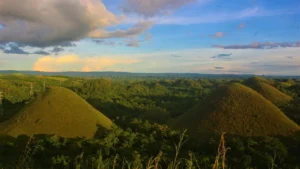
- Chocolate Hills Natural Monument (2006): more than a thousand cone-shaped hills on Bohol.
- Mt. Pulag National Park (2006): Luzon’s highest peak, famous for its sea of clouds.
- El Nido-Taytay Managed Resource Protected Area (2006): limestone islands and lagoons in northern Palawan.
- Mayon Volcano Cultural Landscape (2015): the near-perfect cone of Albay.
- Colonial Urban Plan and Fortifications of the Walled City of Manila (2024): Intramuros beyond San Agustín Church.
- The Sugar Cultural Landscape of Negros and Panay Islands (2024), Kitanglad and Kalatungan Mountain Ranges (2024), Samar Island Natural Park (2024) and an extension of the Rice Terraces (2024).
The full Tentative List, including Butuan, Mt. Iglit-Baco and Mt. Mantalingahan, is on the official UNESCO page for the Philippines.
Frequently Asked Questions
How many UNESCO World Heritage Sites does the Philippines have?
As of 2026 the Philippines has 6 UNESCO World Heritage Sites: 3 cultural (Baroque Churches of the Philippines, Rice Terraces of the Philippine Cordilleras, Historic City of Vigan) and 3 natural (Tubbataha Reefs Natural Park, Puerto-Princesa Subterranean River National Park, Mount Hamiguitan Range Wildlife Sanctuary).
What was the first UNESCO site in the Philippines?
The Baroque Churches of the Philippines and Tubbataha Reefs Natural Park were both inscribed in 1993, the first year the country had sites on the list.
What is the newest UNESCO World Heritage Site in the Philippines?
Mount Hamiguitan Range Wildlife Sanctuary in Davao Oriental, inscribed in 2014.
Are the Banaue Rice Terraces a UNESCO site?
The UNESCO property covers five clusters in Ifugao: Batad, Bangaan, Mayoyao, Hungduan and Nagacadan. Batad and Bangaan are in the municipality of Banaue, but the famous viewpoint terraces next to Banaue town are not part of the inscribed clusters.
Can I see several UNESCO sites in one trip?
Yes. A northern Luzon route links the Rice Terraces, Vigan and the Paoay and Santa Maria churches, while Palawan combines the Underground River with Tubbataha in the diving season. Manila’s San Agustín Church fits into any arrival day.
When is the best time to visit the Philippine World Heritage Sites?
For most sites the dry season from about December to May is best. Tubbataha is the exception: it can only be visited from mid-March to mid-June.
Plan Your Philippines Heritage Trip with PhilippinesAssist
Permits, flights, drivers and local guides arranged by our team on the ground, with fair local prices and help every step of the way.
Plan My Trip Browse Multi-Day Tours Explore Short Excursions